Quick Answer
This article explains Spotify AI policy risk for independent artists by focusing on protecting releases by avoiding unclear rights, fake streams, and misleading metadata. The practical takeaway is to verify current platform or rights rules, keep clean metadata and documentation, and make decisions based on your catalog goals rather than hype, shortcuts, or unsupported claims.
Key Takeaways
- Spotify AI Music Policy 2026: New Rules is mainly about protecting releases by avoiding unclear rights, fake streams, and misleading metadata.
- Artists should keep accurate metadata, release records, and rights documentation.
- Platform, marketplace, and royalty policies can change, so current rules should be verified.
- The safest plan is to protect catalog control while building sustainable audience growth.
Spotify Is Removing AI Music in 2026 — What Independent Artists Must Do Now
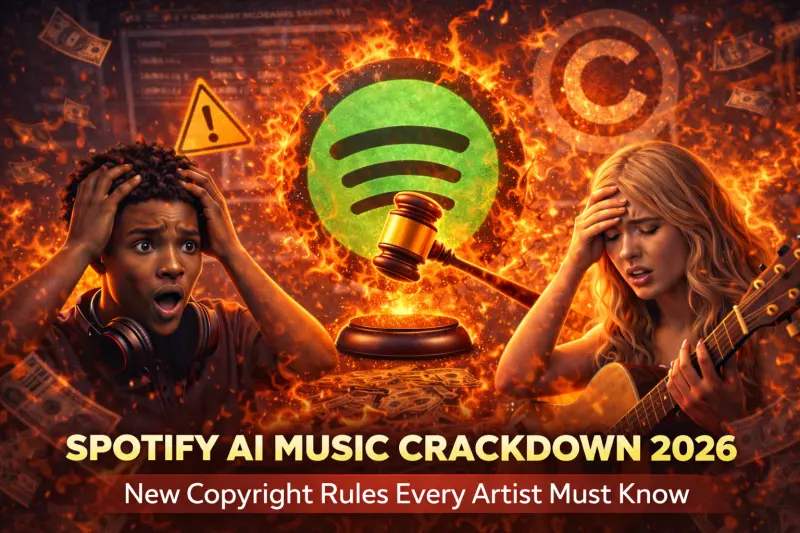
Here’s the reality: spotify is quietly changing the rules — and many artists won’t notice until their music disappears. In 2026, Spotify has begun tightening its policy around AI-generated music, automated uploads, and synthetic tracks — and this update could impact thousands of independent artists worldwide. The streaming giant is striking a delicate balance: supporting legitimate, creative human artists who use modern technology as a tool, while aggressively purging low-effort, mass-produced synthetic tracks that dilute search results and drain the royalty pool.
🚨 What Changed in Spotify’s AI Music Policy?
In 2026, Spotify has deployed advanced AI-detection models at the intake level, co-developed with major distributors. The platform is no longer tolerating:
-
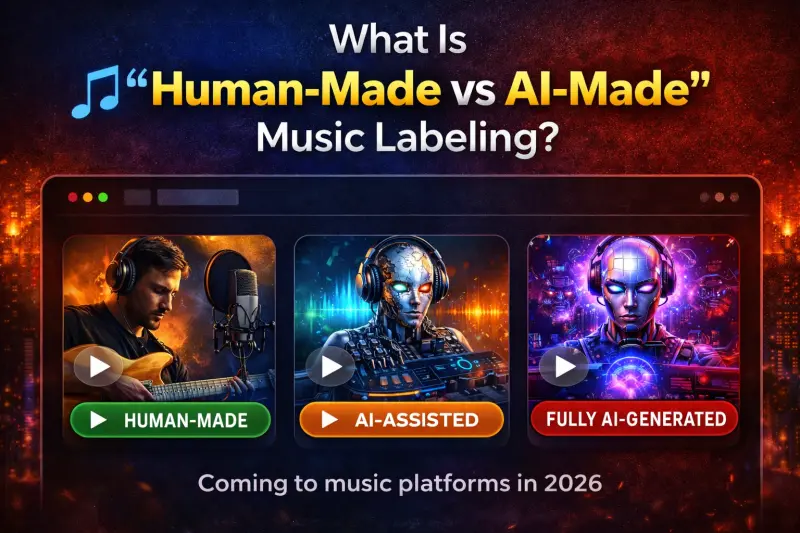
Fully AI-generated tracks with no human creativity: Tracks generated from a single text prompt on tools like Suno or Udio and uploaded directly without further instrumentation, arrangement, or human vocal tracks.
-
Mass-uploaded AI songs: Creators using automated scripts to generate hundreds of lo-fi beats, ambient sounds, or white noise tracks using similar prompts, and publishing them under multiple fake artist names.
-
AI music mimicking real artists: Voice models trained on popular singers without permission. Spotify has partnered with the RIAA to instantly block any tracks featuring deepfake vocals that mimic copyrighted artist likenesses.
Accounts abusing AI uploads are seeing track removals, monetization blocks, and even distributor bans.
🤖 Is AI Music Completely Banned on Spotify?
No — but it’s strictly regulated.
Spotify recognizes that digital audio workstations (DAWs) have incorporated machine learning for years. AI-assisted music is allowed only if:
-
A real human is involved in composition, writing, or production. This means you are using AI as an instrument—generating a drum pattern, splitting a stem, or polishing a mix—rather than outsourcing the entire creative process.
-
The content is original and not trained on copyrighted works. If your generative model uses unlicensed music datasets, you face immediate copyright strikes if a match is detected.
-
You clearly own all rights to melodies, vocals, and sounds, and can provide legal documentation of your commercial tier subscription to the AI tools used.
Pure “prompt-only” AI music is the main target.
💸 Why This Matters for Independent Artists
Many artists rely on AI tools to:
-
Speed up production (e.g., generating synth lines or midi loops)
-
Generate background vocals or references
-
Release content consistently to keep up with the algorithm
But Spotify now treats low-effort AI uploads as spam, which can:
-
Kill your artist profile trust: Spotify uses a hidden "trust score" for artist accounts. High bounce rates, low-quality signals, or flag warnings from stores can permanently damage your visibility.
-
Block future releases: If one of your tracks is flagged, distributors may freeze your account and refuse to distribute future music.
-
Reduce playlist eligibility: Algorithmic playlists like Release Radar and Discover Weekly will automatically filter out tracks identified as low-effort synthetic uploads.
⚙️ How Spotify's AI Detection System Works
Independent artists must understand the mechanisms Spotify uses to identify synthetic content. The platform does not rely on manual review for millions of daily uploads. Instead, it utilizes three main layers of automated screening:
- Acoustic Fingerprinting & Waveform Analysis: Spotify's algorithms analyze the frequency spectrum, transient dynamics, and phase relationships of the audio file. Generative models like Suno and Udio often leave subtle digital artifacts, repetitive phase alignments, and specific dynamic profiles that are invisible to the naked ear but highly distinct to detection software.
- Structural Similarity Checks: Generative AI models are trained on specific pattern templates. The detector compares incoming compositions against a database of known generative structures. If a song's arrangement, chord progression, and instrumentation match generative templates too closely, it is flagged for manual audit.
- Metadata & Behavior Auditing: Uploading speed is a major red flag. If an artist profile suddenly uploads ten albums of 15 tracks each in a single week, the metadata patterns (generic titles like "Soothing Rain Vol. 12") combined with the upload volume will trigger an automatic monetization freeze.
✅ How Artists Can Stay Safe in 2026
To protect your Spotify releases and build a sustainable presence:
-
Use AI only as a support tool, not the creator: Write your own lyrics, record live instruments, and perform your own vocals. Let AI generate inspiration, assist in mastering, or build background textures, but keep the core of the song human.
-
Avoid AI voices that sound like real singers: Even if a voice model is commercially licensed, if it bears a strong acoustic similarity to a mainstream artist, Spotify's automated systems may flag it for trademark violation.
-
Upload fewer, higher-quality tracks: Focus on building a genuine fanbase. Single-driven campaigns with visual assets, music videos, and social media promotion signal to Spotify's algorithms that you are a legitimate human artist.
-
Work with distributors that clearly allow AI-assisted music: Choose transparent platforms like Last Play Distro that help you verify metadata, document your commercial licenses, and defend your rights if your track is falsely flagged.
📈 The Long-Term Outlook for AI-Assisted Art
As we move deeper into 2026, the streaming ecosystem will continue to refine its boundaries. The goal is not to suppress technology, but to protect the human-centric value proposition of music platforms. Creators who use AI to enhance their productivity—such as generating custom reference tracks, analyzing chord patterns, or cleaning up vocal mixes—will find that Spotify's algorithms actually reward their consistency. The key is integration: blending generative tools with live instruments, emotional vocal recordings, and authentic marketing campaigns. By establishing a strong, multi-platform presence, independent artists can build resilient businesses that survive policy shifts and algorithmic changes. Ultimately, the future belongs to creators who leverage technology to amplify their unique artistic voices, rather than those who use prompts to replace the creative process entirely.
🎯 Final Thoughts
Spotify isn’t anti-AI — it’s anti-abuse. The platform is protecting the integrity of its service for users who pay subscription fees and expect high-quality music, not auto-generated noise. Artists who focus on originality, quality, and community building will survive and thrive. Those trying to game the system with bulk-prompted assets won’t.
If you’re an independent artist in 2026, understanding AI music rules isn’t optional anymore — it’s survival.
Release Your Music Globally With Last Play Distro
With Last Play Distro, artists can distribute music globally to 150+ platforms, start on a Free tier where they keep 60% royalties, or upgrade to Premium tiers where they can keep up to 95% royalties.
- Global music distribution for independent artists
- Transparent royalties with plan-based royalty splits
- No fake partner, review, rating, or inflated artist-count claims