Quick Answer
This article explains AI music labeling for independent artists by focusing on preparing for clearer labels around human-made, AI-assisted, and AI-generated music. The practical takeaway is to verify current platform or rights rules, keep clean metadata and documentation, and make decisions based on your catalog goals rather than hype, shortcuts, or unsupported claims.
Key Takeaways
- Human vs AI Music: Platforms to Label Songs in 2026 is mainly about preparing for clearer labels around human-made, AI-assisted, and AI-generated music.
- Artists should keep accurate metadata, release records, and rights documentation.
- Platform, marketplace, and royalty policies can change, so current rules should be verified.
- The safest plan is to protect catalog control while building sustainable audience growth.
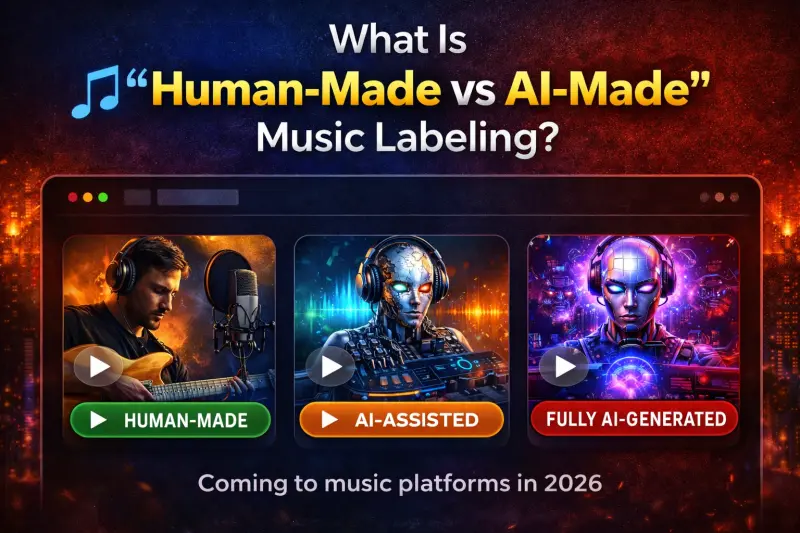
🎵 What Is “Human-Made vs AI-Made” Music Labeling?
AI music isn’t just being restricted anymore — it’s about to be labeled.
In 2026, major music platforms are quietly moving toward a future where every song reveals how it was made.
Instead of banning AI tracks outright, platforms are considering a new transparency system:
-
Human-Made Music – Created primarily by humans
-
AI-Assisted Music – AI used as a tool (mixing, melody ideas, stems)
-
Fully AI-Generated Music – Created entirely by AI prompts
Listeners may soon see this information before hitting play.
🌍 Why Is This Happening in 2026?
The global music industry is under pressure from:
-
Artists demanding protection of originality
-
Labels fighting copyright misuse
-
Governments pushing transparency laws
-
Listeners asking for authenticity
Instead of deleting everything, platforms are choosing classification over chaos.
🚨 Platforms Likely to Adopt AI Music Labels
🎧 Spotify
-
Testing metadata-based AI disclosures
-
Labels may affect algorithmic reach
🍎 Apple Music
-
Focus on “artist-first” transparency
-
Human-created music may get priority placement
📹 YouTube
-
Already requires AI disclosure
-
Music uploads may soon carry visible AI tags
📱 Meta (Instagram & Facebook)
-
Reels & audio tracks could show AI origin badges
-
Impacts reach, monetization & brand safety
💸 How This Affects Artists & Labels
✔️ Positive Impacts
-
Human artists stand out more
-
Better trust with listeners
-
Clear ownership signals
❌ Possible Risks
-
AI-labeled tracks may get less promotion
-
Playlists may avoid AI music
-
Sponsors & brands may reject AI content
This isn’t a ban — but it changes visibility.
🎛️ What Counts as AI-Assisted vs AI-Generated?
| Usage Type | Label Risk |
|---|---|
| AI mastering / cleanup | Low |
| AI melody suggestions | Medium |
| Prompt-based full song | High |
| Voice cloning | Very High |
If AI creates the core composition, expect stricter labeling.
🧠 What Smart Artists Should Do Now
-
Keep project files & stems
-
Document your creative process
-
Avoid full prompt-based generation
-
Use AI as a tool, not a replacement
-
Work with distributors that understand AI policy
This will matter more than ever in 2026.
🔮 The Bigger Picture
AI music isn’t going away.
But in 2026, how you make music may matter as much as what you make.
Transparency is becoming the new currency of trust.
✅ Final Takeaway
The future isn’t Human vs AI.
It’s Honest Music vs Hidden Creation.
Artists who adapt early will survive.
Those who ignore it may disappear from algorithms silently.
Release Your Music Globally With Last Play Distro
With Last Play Distro, artists can distribute music globally to 150+ platforms, start on a Free tier where they keep 60% royalties, or upgrade to Premium tiers where they can keep up to 95% royalties.
- Global music distribution for independent artists
- Transparent royalties with plan-based royalty splits
- No fake partner, review, rating, or inflated artist-count claims