Quick Answer
AI music can be monetized and distributed in 2026 when the creator has commercial rights to the generated audio, owns or licenses the vocals and samples, avoids impersonation, discloses AI involvement where a platform requests it, and does not use streaming manipulation or near-duplicate track flooding.
Key Takeaways
- AI music is not automatically banned, but rights proof matters.
- Distributors can reject tracks for unclear ownership, cloned vocals, misleading artist identity, duplicate uploads, or low-quality mass releases.
- Spotify-facing releases need clean metadata, no fake credits, and no artificial streaming behavior.
- A safe release file includes tool licenses, lyric/vocal ownership, prompt or session notes, artwork rights, and split agreements.
AI music monetization in 2026 is possible, but it is no longer a simple upload-and-wait workflow. Distributors and streaming platforms are separating legitimate AI-assisted music from rights-confused, duplicated, impersonation-based, or fraud-linked releases. This guide consolidates the DistroKid AI content policy topic, CD Baby-style distributor review expectations, Spotify-facing AI music rules, and the most common AI music rejection reasons into one decision framework.
The Approval Baseline for AI Music
A platform does not usually reject a song just because a synth, stem separator, vocal cleanup tool, lyric assistant, mastering model, or generative tool was used. The review question is narrower: can the uploader prove the release is lawful, non-deceptive, and commercially usable?
- Approved condition: the artist has commercial rights to the instrumental, vocal, lyrics, artwork, and samples.
- Approved condition: metadata names the real artist or project and does not imply endorsement from a famous singer, label, or producer.
- Rejected condition: the track uses a cloned voice that sounds like a living artist without permission.
- Rejected condition: the catalog is made of dozens of near-identical prompt outputs uploaded as separate releases.
DistroKid, CD Baby, and Distributor Review Scenarios
Independent distributors are the first gatekeepers. A DistroKid-style workflow may allow upload, then later request clarification or remove content if stores flag it. A CD Baby-style editorial review may be more manual and documentation-heavy before delivery. In both cases, the safest creator treats AI music like any other rights-sensitive release.
Scenario 1: AI-assisted beat with human vocal. A producer creates a drum loop and pad progression with a licensed AI tool, writes original lyrics, records a human vocal, and keeps the subscription license receipt. This is usually lower risk because the artist can explain every input and output.
Scenario 2: Fully generated meditation album. A creator generates 20 long ambient tracks with similar prompts. Monetization risk rises if the tracks sound interchangeable, have generic metadata, or appear designed for stream farming. Approval improves when each track is meaningfully edited, titled accurately, and released as a coherent album rather than bulk filler.
Scenario 3: AI cover voice. A track using a voice model that resembles a famous singer is high risk unless the rights holder approved the vocal likeness. Even if the instrumental is original, the voice identity can trigger rejection.
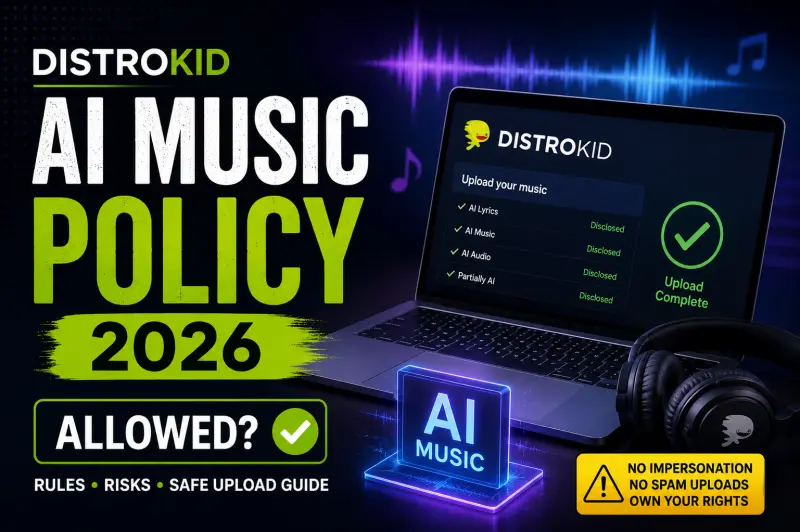
DistroKid AI Music Policy 2026: Complete Rules
DistroKid is one of the largest entry points for independent artists, making its stance on AI-generated tracks highly influential. In 2026, DistroKid's policy allows the distribution of AI-generated music, but only under strict operational guidelines designed to prevent stream manipulation and copyright infringement. If you are uploading tracks generated via tools like Suno, Udio, or other generative platforms, understanding these parameters is critical to preventing your releases from being flagged or your account from being terminated.
First and foremost, DistroKid requires absolute proof of commercial rights. When using generative AI platforms, you must be on a paid subscription tier at the time the audio is generated to claim commercial ownership. DistroKid's automated intake systems regularly cross-reference audio fingerprints and metadata against known AI-generated patterns. If a track is identified as generative, you may receive a request to upload proof of your commercial license. Keeping receipts, license agreements, and export logs from your AI tools is essential to resolve these compliance checks quickly.
Second, voice cloning is a major target for rejection. Uploading a track that uses a voice model mimicking a famous artist (e.g., Drake, Taylor Swift, or Weekend-style vocal clones) without explicit, documented authorization from the original artist's label is strictly prohibited. Even if the musical composition and lyrics are entirely original, the unauthorized use of a voice likeness will trigger immediate store takedowns and can lead to a permanent ban of your DistroKid account.
Third, DistroKid enforces strict rules against bulk submissions of unedited AI music. Submitting dozens of short, raw prompt outputs under generic titles is flagged as potential "stream farming" or "low-value content." Spotify, Apple Music, and Amazon Music have updated their algorithms to filter out unedited ambient loops and spam-like generative albums. DistroKid recommends that artists use generative AI as a tool for inspiration, vocal synthesis, or stem generation, but combine these outputs with human vocals, real instruments, and unique post-production. To stay compliant, ensure each release features distinct song structures, proper metadata, and is distributed under a clearly defined, original artist profile.
Spotify-Facing AI Music Rules
For Spotify-facing distribution, the biggest practical risks are not only copyright. Stores also watch for deceptive credits, artificial streaming, duplicate audio, and low-value catalogs. A song can be technically original and still become risky if the release behavior looks manipulative.
- Lower risk: one edited AI-assisted single with real artist branding, proper credits, and normal promotion.
- Medium risk: AI background music released in volume, but with distinct arrangements, proper album context, and clear rights records.
- High risk: hundreds of short near-identical tracks targeting passive playlists, sleep playlists, or bot-driven streams.
AI Music Rejection Reasons
Most AI music rejections can be traced to one of seven problems: unclear commercial license, unauthorized vocal clone, copyrighted sample, misleading artist name, duplicate audio, poor metadata, or suspected streaming abuse. Rejections are often framed as quality control or rights risk rather than as a blanket AI ban.
If a distributor asks for more information, answer with specifics: tool name, plan/license type, date of creation, what was generated, what was human-edited, who owns the lyrics, and whether any third-party samples or voices were used.
Case-Style Examples for Music Creators
Bedroom producer releasing a hyperpop single: AI was used for a bass texture and mastering reference, while the vocal and lyrics are original. This is a strong approval case if credits and splits are clean.
Faceless lo-fi channel turning prompts into albums: the catalog may earn, but only if the tracks are distinct, rights are documented, and streaming growth is organic. The same 30-second motif repeated across multiple uploads is a warning sign.
Artist using an AI feature voice: if the voice sounds like a celebrity or another independent artist without written permission, distribution and monetization are both at risk.
Monetization Risk Breakdown
| Risk area | What reviewers check | Safer action |
|---|---|---|
| Rights | Tool license, samples, lyrics, voice model | Keep receipts, split sheets, and source notes |
| Identity | Artist name, voice likeness, false features | Do not imply another artist participated |
| Quality | Duplicate audio, mass uploads, generic metadata | Edit, arrange, title, and package releases intentionally |
| Revenue | Bot streams, playlist manipulation, passive catalog abuse | Use normal promotion and avoid paid stream schemes |
AI Music Release Checklist
- Save the AI tool license and confirm commercial use is allowed.
- Document which parts are AI-generated and which parts are human-created.
- Clear every sample, loop, vocal model, artwork asset, and collaborator split.
- Use honest metadata and avoid famous-name bait in artist names, titles, or credits.
- Master and quality-check the track like a normal commercial release.
- Do not upload bulk near-duplicate tracks to chase passive streams.
- Be ready to respond to distributor review requests with exact licensing details.
The practical rule is simple: AI can be part of the music workflow, but the release still has to behave like a real rights-cleared record.
Release Your Music Globally With Last Play Distro
With Last Play Distro, artists can distribute music globally to 150+ platforms, start on a Free tier where they keep 60% royalties, or upgrade to Premium tiers where they can keep up to 95% royalties.
- Global music distribution for independent artists
- Transparent royalties with plan-based royalty splits
- No fake partner, review, rating, or inflated artist-count claims