Quick Answer
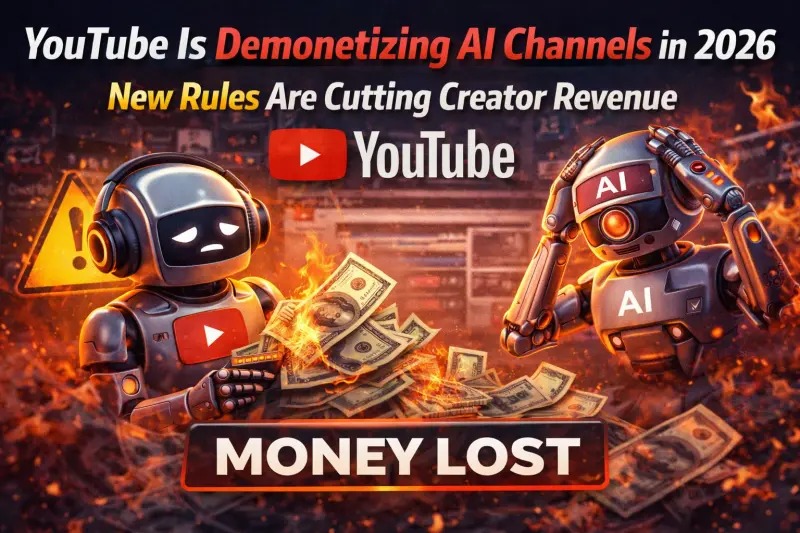
YouTube’s reused content policy does not automatically ban AI videos, faceless channels, reaction videos, clips, compilations, or AI voiceovers. The real issue is whether the video adds clear original value. In 2026, creators should avoid mass-produced AI videos, copied clips with minimal changes, repetitive narration, reused visuals, fake commentary, and low-effort automation. To stay safer for monetization, add original commentary, editing, research, storytelling, analysis, or human creative input that viewers can clearly recognize.
Key Takeaways
- YouTube reused content is mainly about originality, not whether a video is made with AI.
- AI videos and faceless channels can still be monetized if they add meaningful original value.
- Copied clips, repetitive AI narration, mass-produced scripts, and low-effort compilations are high-risk.
- Realistic AI-generated or altered content may need disclosure during upload.
- Reaction, commentary, review, educational, and documentary-style videos are safer when they transform the source material.
- The safest strategy is to use AI as a production assistant, not as a shortcut for automated recycled content.
YouTube Reused Content Policy 2026: AI Videos, Faceless Channels & Monetization
YouTube reused content is one of the biggest reasons creators get rejected from the YouTube Partner Program or lose monetization after review.
In 2026, the topic is even more confusing because AI videos, faceless channels, AI voiceovers, recycled clips, automated news videos, shorts compilations, and mass-produced content are everywhere.
But the rule is not as simple as:
“AI content is banned.”
That is not accurate.
The real question is:
Does your video add enough original value that viewers can clearly tell it is meaningfully different from the source material?
That is the core of YouTube’s reused content policy.
A faceless channel can be monetized.
An AI-assisted video can be monetized.
A reaction video can be monetized.
A commentary video using clips can be monetized.
But low-effort reused content, copied videos, repeated templates, AI narration over recycled visuals, and mass-produced videos with no real transformation can create serious monetization risk.
What Is YouTube Reused Content?
YouTube reused content usually means content that relies too heavily on material that already exists, without adding enough original value.
This can include:
- copied clips from other creators
- compilations with little or no commentary
- reaction videos with minimal reaction
- AI voiceovers reading copied scripts
- reused stock footage with generic narration
- repeated video templates
- mass-produced Shorts using the same format
- movie or TV clips with no real analysis
- sports or news clips with no original explanation
- TikTok or Instagram reposts uploaded to YouTube
The important point is this:
Using existing material does not automatically make a video reused content.
The problem starts when your contribution is too weak.
If viewers cannot clearly tell what you added, YouTube may treat the content as low-value or reused.
Does YouTube Allow Reused Content to Monetize?
Yes, reused content can be monetized when it is meaningfully transformed.
YouTube’s own policy explains that reused content may be allowed when viewers can clearly tell there is a meaningful difference between the original video and the creator’s version. Examples include critical reviews, rewritten dialogue, explanatory sports replays, reaction videos with commentary, and edited footage with added storyline or commentary.
So the focus is not only on whether you used someone else’s material.
The focus is on what you added.
Safer reused-content formats usually include:
- criticism
- commentary
- education
- analysis
- documentary context
- storytelling
- original editing
- voiceover explanation
- comparison
- review
- transformation
Risky formats usually include:
- copied clips with no commentary
- “best moments” compilations
- AI voice reading generic facts
- repeated slideshow videos
- videos made from scraped content
- auto-generated news summaries
- reused Shorts from other platforms
- fake reaction videos
- low-effort template content
Are AI Videos Allowed Under YouTube Reused Content Policy?
AI videos are not automatically banned.
YouTube does not judge a video only because AI was used. The bigger issue is whether the final video is original, useful, and clearly transformed.
AI can be used safely for:
- brainstorming
- outlines
- captions
- thumbnails
- editing support
- script improvement
- voice repair
- visual concepts
- translation assistance
- production planning
But AI becomes risky when it replaces the creator completely.
For example, a channel that mass-produces hundreds of videos using the same AI voice, same stock footage, same script format, and same recycled ideas may look low-value even if every video is technically “new.”
YouTube wants creators to make content that feels intentional, useful, and original.
AI should support the creator.
It should not become a machine for recycled uploads.
Faceless YouTube Channels: Allowed or Risky?
Faceless channels can still be monetized in 2026.
A faceless format is not the problem.
Many successful educational channels, documentary channels, history channels, finance explainers, tech channels, music channels, and animation channels are faceless.
The problem is when the channel looks automated.
A faceless channel becomes risky when it uses:
- robotic AI narration
- generic scripts
- repeated footage
- copied clips
- no original research
- no unique editing
- no real structure
- no visible creator input
- mass uploads with similar titles and thumbnails
A faceless channel becomes safer when it includes:
- original research
- strong script structure
- unique voiceover direction
- human editing
- custom visuals
- original examples
- clear storytelling
- useful commentary
- consistent topic expertise
So the rule is simple:
Faceless is fine.
Low-effort automation is not.
AI Voiceovers and Reused Content Risk
AI voiceovers are one of the biggest confusion points.
Using an AI voice does not automatically make a video reused content.
But AI voiceovers can make a video feel low-effort when the rest of the content is also generic.
High-risk AI voiceover videos usually look like this:
- AI reads a copied article
- stock footage plays in the background
- no unique commentary is added
- the same format repeats across many videos
- clips are taken from other creators
- script is generic and shallow
- thumbnails and titles are clickbait
- videos are uploaded in bulk
Safer AI voiceover videos look like this:
- original script
- original research
- clear human editing
- custom examples
- helpful explanation
- unique visual structure
- meaningful transformation
- topic expertise
The voice itself is not the full issue.
The issue is whether the video has enough original value.
Reaction Videos and Commentary Content
Reaction videos can be monetized, but only when the creator adds enough value.
A real reaction video is not just someone watching another video.
It should add something meaningful, such as:
- commentary
- criticism
- explanation
- humor
- context
- educational breakdown
- fact-checking
- comparison
- professional opinion
For example, a music producer reacting to a song and explaining the mix, vocals, arrangement, instruments, or production choices is adding original value.
But a creator silently watching someone else’s video, pausing rarely, and uploading most of the original content is much riskier.
For music artists and producers, reaction content can work well if it is actually educational.
Examples:
- breaking down a viral song arrangement
- explaining why a hook works
- reviewing an artist’s mix
- comparing two production styles
- reacting to music marketing campaigns
- analyzing a live performance
That is much stronger than simply replaying someone else’s content.
Compilations, Clips, and Shorts Reuploads
Compilation channels are high-risk if they do not add clear transformation.
This includes:
- funny clips compilations
- sports highlight compilations
- TikTok repost compilations
- podcast clip dumps
- movie scene uploads
- reaction clip compilations
- viral Shorts reposts
- “top 10” videos made from other people’s content
A compilation becomes safer when the creator adds:
- narration
- ranking logic
- explanation
- original editing
- educational context
- commentary between clips
- visual overlays
- comparison
- story structure
But simply putting clips together with background music is weak.
YouTube wants viewers to understand what you created, not just what you collected.
Repetitive Content vs Reused Content
Reused content and repetitive content are related, but they are not exactly the same.
Reused content usually involves content taken from another source without enough transformation.
Repetitive content usually means the creator is uploading too many videos that feel almost the same.
A channel can have repetitive content even if every video is technically original.
Examples of repetitive content:
- same AI voice in every video
- same script structure
- same background footage
- same topic repeated with small changes
- same thumbnail template
- same title pattern
- same listicle format
- same generic advice
- mass-produced Shorts
This matters because many AI channels do not fail because one video is copied.
They fail because the entire channel looks mass-produced.
Does AI Disclosure Affect YouTube Monetization?
YouTube says creators need to disclose realistic AI-generated or meaningfully altered content when viewers could mistake it for real.
Examples include:
- making a real person appear to say something they did not say
- altering footage of a real event or place
- generating a realistic scene that did not happen
- AI-generated realistic music or visuals
- realistic depictions involving public figures, real places, or real events
But disclosure itself is not supposed to automatically limit a video’s audience or monetization eligibility.
This is important.
Disclosing AI use does not mean your video is demonetized.
The bigger risk is not disclosing realistic AI content when disclosure is required.
If creators repeatedly fail to disclose required AI content, YouTube may apply labels manually or take stronger action, including content removal or suspension from the YouTube Partner Program.
So the safe approach is:
If realistic AI content could confuse viewers, disclose it.
Examples of Safer YouTube Content in 2026
Here are examples of content formats that are generally safer under reused content policy:
1. Educational explainers
A creator explains a topic using original script, research, visuals, and examples.
2. Commentary videos
The creator discusses news, culture, music, creator economy, or platform updates with original opinion and context.
3. Music production breakdowns
A producer explains how a song, beat, mix, hook, or vocal effect works.
4. Documentary-style videos
The creator uses clips, screenshots, and references but adds narration, timeline, analysis, and storytelling.
5. Review videos
The creator reviews tools, songs, platforms, apps, music distributors, or creator monetization systems with original judgment.
6. AI-assisted videos with human direction
The creator uses AI for support but controls the script, editing, structure, examples, and final message.
7. Reaction videos with real analysis
The creator adds enough commentary that viewers watch for the creator’s perspective, not only for the original clip.
Examples of Risky Content
These formats are much riskier:
- AI voice reading Wikipedia-style scripts
- copied TikTok clips uploaded to Shorts
- podcast clips with no commentary
- movie clips with only subtitles
- sports clips with no explanation
- music lyric videos made from copyrighted songs without rights
- fake celebrity AI videos
- AI news channels using copied headlines
- “top 10” videos built from stock footage and generic narration
- mass-uploaded faceless videos with repeated templates
- compilations with no clear transformation
- videos pretending synthetic AI scenes are real
These videos may still get views, but monetization can become unstable.
How Music Artists Should Think About Reused Content
For independent artists, this policy matters in two ways.
First, artists often use YouTube to promote songs through lyric videos, visualizers, Shorts, behind-the-scenes clips, AI visuals, remix clips, and reaction content.
Second, artists may rely on Content ID, YouTube Music, Shorts, and user-generated content for revenue.
That means rights and originality both matter.
Safer artist content includes:
- official music videos
- lyric videos using your own song
- visualizers with original artwork
- Shorts using your released music
- behind-the-scenes studio videos
- breakdowns of your production process
- explainers about your lyrics
- commentary on your own creative process
- AI visuals that you have rights to use
- properly licensed remixes or edits
Riskier artist content includes:
- uploading someone else’s song with AI visuals
- using copyrighted clips as background
- reposting viral music videos
- uploading slowed/reverb versions without rights
- AI voice cloning real artists
- claiming Content ID on music you do not fully control
- using generic AI loops with unclear rights
If the content is tied to your catalog, keep proof of ownership, stems, licenses, release metadata, and rights documentation.
How to Make AI or Faceless Videos Safer for Monetization
Use this checklist before publishing:
1. Add original commentary
Do not just show clips. Explain what the viewer should understand.
2. Write a real script
Avoid generic AI text. Add examples, opinions, and original structure.
3. Use better editing
Add cuts, overlays, zooms, captions, screenshots, diagrams, and visual pacing.
4. Avoid mass uploads
Publishing too many similar AI videos can make the channel look automated.
5. Use original or licensed visuals
Do not rely only on copied clips from other creators.
6. Disclose realistic AI content
If AI content looks real, use YouTube’s AI disclosure option during upload.
7. Avoid fake claims
Do not present AI-generated scenes, voices, or people as real.
8. Keep documentation
Save licenses, project files, prompts, editing files, voice licenses, and source links.
9. Build topic authority
Channels with clear expertise and consistent value are safer than random trend-chasing channels.
10. Think like a reviewer
Ask yourself: if a YouTube reviewer manually checks this channel, will they see real creator effort?
If the answer is no, the content is risky.
What YouTube Reviewers May Look For
When a channel applies for monetization or gets reviewed, YouTube may look beyond one single video.
The reviewer may judge the whole channel.
They may look at:
- video originality
- upload patterns
- repeated templates
- use of clips
- commentary quality
- narration quality
- visual originality
- channel topic focus
- viewer value
- rights and copyright issues
- AI disclosure behavior
- whether videos feel mass-produced
This is why creators should not think only about one viral video.
A channel needs a pattern of original value.
Best Strategy for 2026
The safest YouTube strategy in 2026 is not to avoid AI completely.
The safest strategy is to avoid lazy AI.
Use AI for speed, but add human judgment.
Use AI for ideas, but add original insight.
Use AI for visuals, but avoid misleading viewers.
Use AI voice if needed, but make the script and editing strong.
Use clips if needed, but add commentary and transformation.
The creators who survive YouTube reused content reviews will be the ones who make content that clearly feels intentional, useful, and original.
Final Verdict
YouTube reused content policy in 2026 is not a simple ban on AI videos, faceless channels, clips, reactions, or AI voiceovers.
The real issue is original value.
If your video only collects, repeats, reads, reposts, or lightly edits content that already exists, monetization is risky.
If your video adds clear commentary, research, analysis, editing, education, storytelling, or creative direction, it has a much stronger chance of staying monetization-safe.
For creators and independent artists, the rule is simple:
Do not use AI to mass-produce recycled content.
Use AI to create better, more original content.
FAQ: YouTube Reused Content Policy 2026
What is YouTube reused content policy in 2026?
YouTube reused content policy focuses on whether a video adds meaningful original value. Reused content may still be monetized when viewers can clearly see that the creator has transformed the original material through commentary, editing, analysis, education, storytelling, or another original contribution.
Are AI videos allowed to monetize on YouTube?
Yes, AI videos are not automatically banned from YouTube monetization. The risk comes from low-effort automation, repeated templates, copied visuals, synthetic narration with no original value, or videos that mislead viewers.
Can faceless YouTube channels monetize in 2026?
Yes, faceless YouTube channels can still monetize if the content is original, useful, and clearly transformed. A faceless format is not the problem. The problem is mass-produced content, copied clips, repeated scripts, and videos that feel automated.
Does YouTube require AI content disclosure?
YouTube requires creators to disclose realistic AI-generated or meaningfully altered content when viewers could believe that something real happened, a real person said something, or a real scene occurred. Minor AI assistance like outlines, captions, or basic editing support may not always require disclosure.
Can reaction videos be monetized under reused content policy?
Reaction videos can be monetized when the creator adds meaningful commentary, criticism, analysis, humor, or context. Simply replaying someone else’s video with minimal reaction or very little commentary can create reused content risk.
Are AI voiceover videos reused content?
AI voiceover videos are not automatically reused content. They become risky when the same synthetic voice, generic script, stock footage, and repeated format are used with little original value or human direction.
How can creators avoid reused content issues on YouTube?
Creators should add original commentary, research, editing, visuals, examples, personal insight, or educational value. They should avoid copied clips, mass uploads, repeated templates, fake news-style videos, and AI-generated content that looks automated or misleading.
Is this legal or monetization approval advice?
No. This article provides general educational guidance for creators and independent artists. YouTube policies and monetization reviews can change, so creators should always check YouTube’s latest official rules before relying on monetization.
Release Your Music Globally With Last Play Distro
With Last Play Distro, artists can distribute music globally to 150+ platforms, start on a Free tier where they keep 60% royalties, or upgrade to Premium tiers where they can keep up to 95% royalties.
- Global music distribution for independent artists
- Transparent royalties with plan-based royalty splits
- No fake partner, review, rating, or inflated artist-count claims