
Quick Answer
This article explains AudioJungle AI policy for independent artists by focusing on checking marketplace rules before selling AI-assisted or AI-generated stock music. The practical takeaway is to verify current platform or rights rules, keep clean metadata and documentation, and make decisions based on your catalog goals rather than hype, shortcuts, or unsupported claims.
Key Takeaways
- AudioJungle AI Music Policy Explained (2026) is mainly about checking marketplace rules before selling AI-assisted or AI-generated stock music.
- Artists should keep accurate metadata, release records, and rights documentation.
- Platform, marketplace, and royalty policies can change, so current rules should be verified.
- The safest plan is to protect catalog control while building sustainable audience growth.
📜 AudioJungle’s Position on AI Music
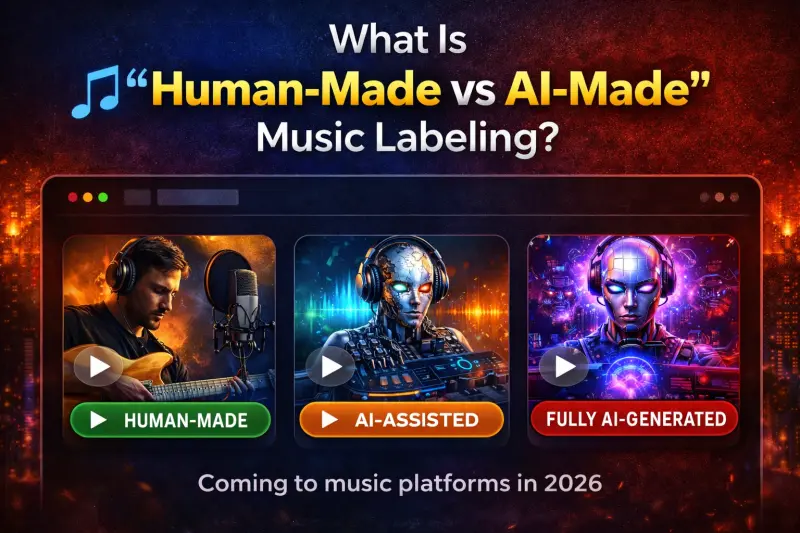
AI music is flooding marketplaces — but not all platforms are welcoming it.
In 2026, AudioJungle has taken a firm stance on AI-generated tracks, enforcing some of the strictest quality and ownership controls in the microstock audio industry. Because stock music buyers represent commercial developers, advertisers, and broadcasters, AudioJungle must prioritize liability-free content above all else.
AudioJungle allows some AI-assisted music, but strictly prohibits:
-
Fully AI-generated tracks: Submissions created entirely by typing text prompts into models like Suno, Udio, or other commercial audio generation platforms.
-
Content trained on copyrighted datasets without permission: Any audio output generated by neural networks trained on copyrighted or unlicensed music catalog files.
-
Mass-uploaded AI loops or templates: The practice of flooding the catalog with dozens of minor variations of generated music files to capture marketplace real estate.
Human involvement is mandatory for every submission.
✅ What Is Allowed on AudioJungle
✔️ AI used for:
-
Sound enhancement: Using neural-network-based denoising, audio restoration, or vocal isolation tools to improve raw recordings.
-
Mixing or mastering: Utilizing tools like iZotope Ozone, smart equalizers, or automated compression references during the final production stages.
-
Idea generation with human composition: Generating chord progressions or rhythm outlines as a brainstorming starting point, provided the actual performance and arrangement are completed manually in a DAW.
✔️ Original compositions where:
-
The human is the primary creator and composer of all melodies, stems, and arrangements.
-
Rights are clearly owned, and project session files are available to prove the creative workflow.
❌ What Is NOT Allowed
❌ Prompt-only AI music generated by third-party web apps.
❌ Voice cloning without explicit legal contracts and rights documentation.
❌ Stock music generated entirely by AI tools that lack commercial clearance.
❌ Content without clear ownership proof (including missing license agreements for AI-assisted plugins).
Violations can lead to immediate item rejection, portfolio removal, and permanent account termination.
⚠️ Disclosure Rules in 2026
Creators are expected to:
-
Disclose AI usage honestly: When uploading, you must declare if any AI tools or smart plugins were used during the composition, vocal synthesis, or post-production phases.
-
Ensure exclusivity claims are accurate: Stock music licenses (especially exclusive ones) require that no other party can claim ownership of the identical or highly similar waveform.
-
Respond to manual reviews if flagged: If an AudioJungle reviewer detects machine artifacts, you must provide session screenshots and stem files within 48 hours.
Undisclosed AI use is considered policy abuse and leads to immediate asset freezes.
🌍 Why AudioJungle Is Strict
Reasons include:
-
Buyer trust protection: Commercial buyers use AudioJungle assets in corporate videos, television programs, and video games. If a buyer receives a YouTube Content ID claim or copyright strike because a purchased track contains uncleared generative patterns, Envato (AudioJungle's parent company) faces significant legal liabilities.
-
Copyright risk management: Since generative models are trained on scraped datasets, selling AI-generated compositions exposes the marketplace to trademark and patent infringement suits.
-
Marketplace quality control: Flooding the search database with unoriginal, repetitive tracks makes it harder for buyers to find premium content, destroying search utility.
-
Legal pressure around AI training data: Global copyright offices are establishing that machine-generated content cannot be legally copyrighted, making it impossible to guarantee exclusive stock rights.
AudioJungle is prioritizing buyers, not volume sellers.
🔄 The Role of Envato Elements and Subscription Models
Envato Elements (AudioJungle's parent subscription service) has reshaped how stock music is consumed in 2026. Buyers pay a monthly subscription fee for unlimited downloads, which has driven down the per-download payout for creators. To maintain profitability, some sellers turned to automated AI generation to build massive catalogs. However, Envato's updated Terms of Service explicitly forbid the use of AI generators to inflate portfolios. They have implemented deep scan sweeps that check upload logs and cross-reference audio signatures against competitor catalogs. If a seller is found to have used automated engines to mass-produce tracks for Envato Elements, their entire account—including historical earnings and active portfolios—is closed immediately. This makes quality and distinct, human-crafted compositions the only viable route to long-term stock music revenue.
📄 Buyer Verification and the DMCA Shield
When a buyer purchases a stock track, they receive a PDF license certificate that acts as a DMCA shield. This certificate verifies that the composer has granted a legal clearance for public use. If the composer used generative AI tools without clearing the underlying model rights, the buyer's license is legally void. To prevent legal disputes, major commercial clients are now using automated software to verify that the music files in their video projects do not contain flagged machine-generated audio. Compositions on AudioJungle must be completely clean of unlicensed synthetic artifacts to protect Envato's buyers from legal risk.
🧠 How Creators Can Stay Safe
-
Treat AI as a tool, not a composer. Write your own hooks, arrange your own transitions, and perform your own tracks.
-
Keep project files and creation proof. Organize your DAW sessions, keep receipts for your plugins, and archive your raw multi-tracks.
-
Avoid bulk AI uploads. Focus on uploading 3-5 high-quality, uniquely produced stock assets per week rather than dozens of auto-generated tracks.
-
Read policy updates regularly. Envato's guidelines adapt quickly to match changes in copyright laws and buyer trends.
✅ Final Takeaway
AudioJungle is not anti-AI.
It’s anti-unverified and low-effort AI content that threatens the security of commercial buyers.
Creators who adapt properly and use AI to enhance their human composition workflows can still thrive on the platform.
Release Your Music Globally With Last Play Distro
With Last Play Distro, artists can distribute music globally to 150+ platforms, start on a Free tier where they keep 60% royalties, or upgrade to Premium tiers where they can keep up to 95% royalties.
- Global music distribution for independent artists
- Transparent royalties with plan-based royalty splits
- No fake partner, review, rating, or inflated artist-count claims