Quick Answer
This article explains UMG and Nvidia AI music for independent artists by focusing on tracking major-label AI moves without assuming every artist can use the same rights framework. The practical takeaway is to verify current platform or rights rules, keep clean metadata and documentation, and make decisions based on your catalog goals rather than hype, shortcuts, or unsupported claims.
Key Takeaways
- Universal Music & Nvidia “Music Flamingo” AI Model in 2026 is mainly about tracking major-label AI moves without assuming every artist can use the same rights framework.
- Artists should keep accurate metadata, release records, and rights documentation.
- Platform, marketplace, and royalty policies can change, so current rules should be verified.
- The safest plan is to protect catalog control while building sustainable audience growth.
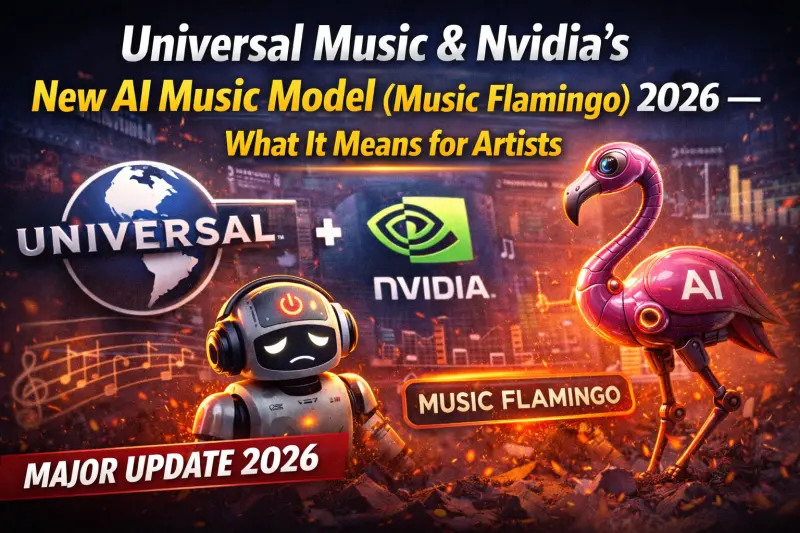
Universal Music & Nvidia’s New AI Music Model (Music Flamingo) 2026 — What It Means for Artists
In early 2026, one of the biggest names in music — Universal Music Group (UMG) — announced a landmark partnership with Nvidia aimed at integrating advanced AI into the music creation and discovery process. The Verge
This collaboration represents a major shift in how the global music industry approaches artificial intelligence, departing from years of lawsuits and skepticism toward AI, and instead embracing AI as a tool for enhancing creativity and engagement while attempting to protect artists’ rights.
Here’s what artists, creators, and industry watchers need to know about this trend and how it could reshape music creation and distribution in 2026 and beyond.
🤖 What Is the AI Model “Music Flamingo”?
Unlike traditional AI music tools that simply generate sound, Music Flamingo is designed to understand structure, harmony, rhythm, and emotional progression in music — interpreting songs more like a human than a machine. The Verge
In simple terms:
-
It analyzes music deeply, not just generate it.
-
It can help with discovering trends, categorizing songs, and suggesting new creative directions.
-
It may impact playlisting, recommendations, and artist promotion.
This is far more advanced than early AI models that simply stitched together beats or melodies.
🎵 Why This Partnership Matters
🧠 From Lawsuits to Innovation
Just a few years ago, major labels were filing lawsuits over AI usage and copyright infringement. Today, UMG is using AI responsibly to enhance music discovery and creation. The Verge
This signals two major trends:
-
The music industry now recognizes AI as a key tool for the future.
-
Responsible AI — not mass AI — will be the accepted standard.
In other words, simply using AI to churn out songs won’t cut it anymore — quality and ethical usage matter.
💡 What This Means for Creators
📌 1. Smart Tools for Music Analysis
Artists could soon use AI systems to understand why certain songs succeed:
-
Which parts connect emotionally with listeners?
-
Which chord progressions or structures work best?
-
What themes resonate in specific markets?
This is a huge advantage over older, purely generative models.
📌 2. Better Music Discovery
AI could help listeners find music not just by genre but by:
-
Emotions
-
Cultural context
-
Rhythmic patterns
This could redefine how artists reach audiences.
📌 3. Copyright Awareness is Still Critical
Despite the optimism, artists should not forget:
-
AI is trained on large datasets.
-
Ownership and attribution remain core legal concerns.
-
Rights violations can still lead to takedowns or legal trouble.
AI that augments creativity is valued over AI that simply duplicates content.
🎤 What UMG and Nvidia Are Promising
The partnership isn’t just about better algorithms — it’s about:
-
Responsible AI use
-
Artist-centric tools
-
New ways to analyze and promote music
UMG executives emphasize that AI should support human creativity, not replace it — a message that resonates deeply in 2026’s music ecosystem. Pitchfork
📈 Long-Term Outlook
This collaboration could shift the industry toward:
-
AI-assisted songwriting
-
AI-driven fan engagement
-
Personalized listening experiences
Creators who adapt early could find themselves ahead in music production and distribution.
🧠 Final Thought
AI in music is not a threat — it’s a transformation. But in 2026 and beyond, only AI that respects rights, enhances creativity, and empowers artists will truly succeed.
This is not just a tech story — it’s a cultural shift.
Release Your Music Globally With Last Play Distro
With Last Play Distro, artists can distribute music globally to 150+ platforms, start on a Free tier where they keep 60% royalties, or upgrade to Premium tiers where they can keep up to 95% royalties.
- Global music distribution for independent artists
- Transparent royalties with plan-based royalty splits
- No fake partner, review, rating, or inflated artist-count claims