Quick Answer
This article explains AI music rejection for independent artists by focusing on understanding why AI-heavy releases may be rejected and how to reduce policy risk. The practical takeaway is to verify current platform or rights rules, keep clean metadata and documentation, and make decisions based on your catalog goals rather than hype, shortcuts, or unsupported claims.
Key Takeaways
- AI Music Rejected by Spotify? New 2026 Policy Explained is mainly about understanding why AI-heavy releases may be rejected and how to reduce policy risk.
- Artists should keep accurate metadata, release records, and rights documentation.
- Platform, marketplace, and royalty policies can change, so current rules should be verified.
- The safest plan is to protect catalog control while building sustainable audience growth.
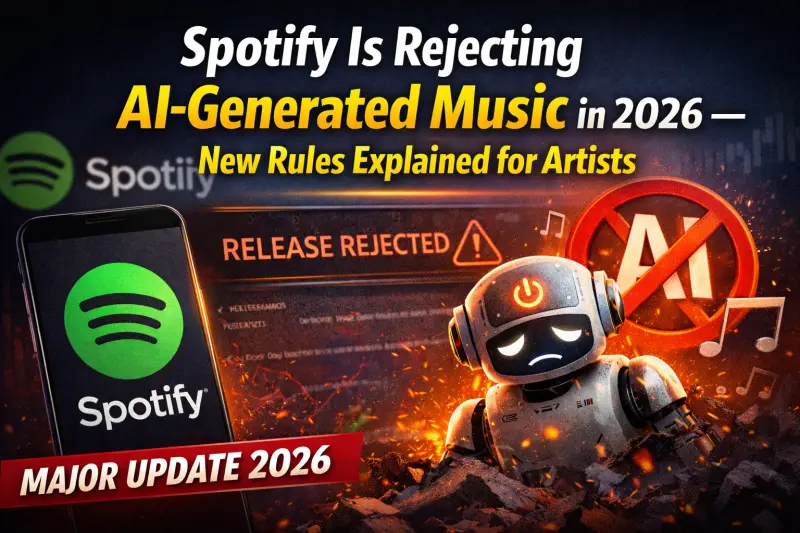
🚨 Spotify Is Rejecting AI-Generated Music in 2026 — New Rules Explained for Artists
In 2026, many independent artists and labels are reporting a sudden increase in Spotify release rejections, especially for AI-generated music. Tracks that were previously accepted are now being delayed, flagged, or outright rejected.
So what changed?
Spotify has quietly tightened its review process for AI-generated content — and if you don’t understand these new rules, your music may never go live.
Here’s everything artists need to know.
🤖 Why Spotify Is Cracking Down on AI-Generated Music
Spotify is under growing pressure from:
-
Copyright holders
-
Major labels
-
Publishers
-
Regulators
The main concern is ownership and originality.
Spotify wants to ensure that:
-
The uploader owns 100% rights
-
AI models were trained legally
-
No copyrighted melodies, vocals, or samples are reused
Because of this, Spotify now treats AI-generated music as high-risk content.
❌ Common Reasons AI Music Is Rejected on Spotify
If your AI-generated track is rejected, it’s usually due to one of these reasons:
1️⃣ No Proof of Rights
Spotify may ask:
-
Who created the music?
-
Which AI tool was used?
-
Do you own the output commercially?
2️⃣ “Generic or Low-Quality Content”
Mass-produced AI tracks are being filtered out to prevent platform spam.
3️⃣ Voice or Melody Similarity
If AI vocals sound too similar to real artists, the release can be blocked.
4️⃣ Metadata Issues
Incorrect artist name, unclear contributors, or missing credits trigger rejections.
⚠️ Does Spotify Completely Ban AI Music?
No — AI music is not fully banned.
Spotify still allows AI-generated music if:
-
You fully own the rights
-
The AI tool allows commercial use
-
The music is original and unique
-
Proper disclosures are provided
However, approval is now manual-heavy and strict.
✅ How to Safely Upload AI Music to Spotify in 2026
To reduce rejection risk:
-
Use reputable AI tools with clear licenses
-
Avoid cloning real artists’ voices
-
Edit and arrange AI outputs manually
-
Add clear metadata and credits
-
Upload fewer, higher-quality tracks
Quality matters more than quantity in 2026.
📉 Why Some AI Tracks Go Live While Others Don’t
Spotify evaluates:
-
Artist history
-
Upload frequency
-
Track uniqueness
-
Listener behavior signals
New accounts uploading many AI tracks quickly are the most likely to get rejected.
🔐 Final Advice for Artists
AI tools are powerful — but Spotify wants real creativity, not automation abuse.
If you plan to use AI:
-
Treat it as a tool, not a shortcut
-
Add human creativity and originality
-
Stay transparent about your process
In 2026, Spotify rewards authentic creators, not mass AI uploads.
Conclusion
Spotify is not killing AI music — it’s killing low-effort AI content.
Artists who adapt to these new rules can still release AI-assisted music successfully, while those trying to game the system will be filtered out.
Release Your Music Globally With Last Play Distro
With Last Play Distro, artists can distribute music globally to 150+ platforms, start on a Free tier where they keep 60% royalties, or upgrade to Premium tiers where they can keep up to 95% royalties.
- Global music distribution for independent artists
- Transparent royalties with plan-based royalty splits
- No fake partner, review, rating, or inflated artist-count claims