Quick Answer
This article explains Spotify royalty changes for independent artists by focusing on responding to payout changes with better release planning, fan growth, and catalog strategy. The practical takeaway is to verify current platform or rights rules, keep clean metadata and documentation, and make decisions based on your catalog goals rather than hype, shortcuts, or unsupported claims.
Key Takeaways
- Spotify Royalty Changes 2026:Why Artists Are Earning Less is mainly about responding to payout changes with better release planning, fan growth, and catalog strategy.
- Artists should keep accurate metadata, release records, and rights documentation.
- Platform, marketplace, and royalty policies can change, so current rules should be verified.
- The safest plan is to protect catalog control while building sustainable audience growth.
Spotify Royalty Changes 2026: What Actually Changed?
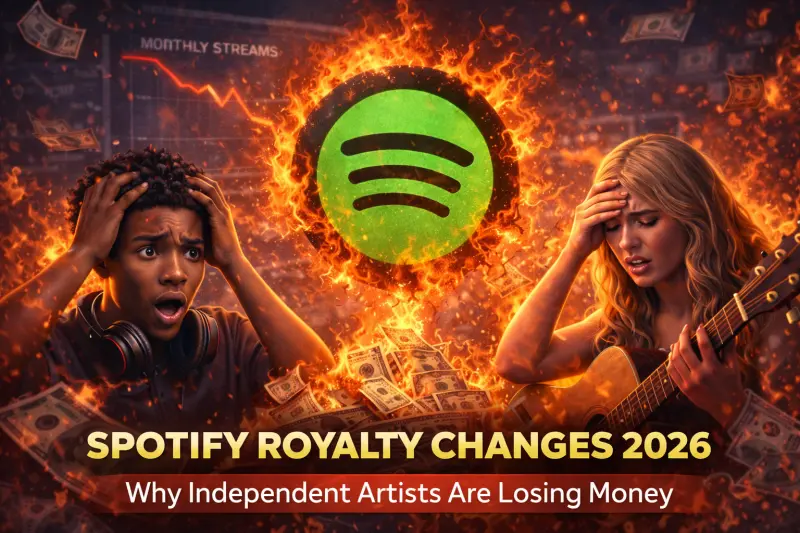
Spotify quietly changed its royalty system — and millions of independent artists didn’t notice.
In 2026, low-stream artists are earning less than ever, even with more plays. The streaming ecosystem has transitioned from a pure pro-rata distribution system to a tiered model that penalizes low-engagement uploads and redistributes funds to mainstream catalogs.
Spotify has updated how royalties are calculated in 2026, and the biggest impact is on independent and low-stream artists who lack a dedicated, active listener base.
Here’s what changed:
-
Tracks with very low streams earn $0: Tracks that fail to cross the annual stream count floor generate no royalty pool allocations.
-
Royalties are pooled differently: Funds that would have gone to low-stream tracks are pooled and redirected to a separate fund for high-performing artists.
-
Fake or low-engagement streams are filtered harder: Artificial streaming detection sweeps run weekly, and suspicious activity leads to immediate stream count deduction.
-
Background/noise content is heavily demonetized: Non-music content (like rain sounds, white noise, static) has a different payout structure requiring longer durations to monetize.
Spotify says this is to fight fraud and support professional music creation — but real independent artists are getting hit too.
Why Small Artists Are Losing Money
Earlier, even 100–500 streams generated some payout, accumulating fractionally over time.
Now, if your track doesn’t cross a minimum engagement threshold of 1,000 streams within a rolling 12-month period, it earns nothing. Furthermore, Spotify requires a minimum number of unique listeners per track to ensure creators aren't loop-streaming their own tracks to cross the floor.
This affects:
-
New and developing artists launching their first releases
-
Niche genre producers (e.g., noise, ambient, avant-garde, micro-tonal)
-
Remix, loop, and instrumental creators
-
Artists using AI-assisted music without a pre-existing marketing strategy
Even if your song is entirely legitimate, Spotify may not count it for royalties if it remains in the long-tail discovery zone.
The Distributor Penalty Reality
To enforce these rules, Spotify has introduced penalty fees for music distributors. If a distributor delivers a high percentage of tracks flagged for artificial streaming or copyright infringement, Spotify charges the distributor a direct penalty fee per track. In response, distributors like DistroKid and TuneCore have implemented aggressive filtering. They pass these penalties down to artists by freezing balances, terminating accounts, and charging fees to clear flags. This makes self-distribution riskier for creators who do not closely monitor their stream sources.
📊 Historical Payout Trends and the Value of a Stream
To understand the gravity of these 2026 changes, one must look at the historical context of music streaming payouts. In the early days of Spotify, the royalty model was a simple pro-rata system: all subscription and advertising revenues were pooled, and then divided by the total number of streams on the platform. If your songs accounted for 0.01% of all streams, you received 0.01% of the royalty pool. While this model was transparent, it encouraged bad actors to upload massive volumes of auto-generated content (such as 30-second silence tracks or generic noise loops) to capture a slice of the pool. By establishing a stream floor of 1,000 plays, Spotify has effectively demonetized millions of these spam-like files. While this protects the financial interests of major labels and mid-tier independent artists, it creates a steep barrier for new creators who are launching their first projects without pre-existing marketing resources.
Is This Legal? Yes — And That’s the Problem
Spotify updated its terms of service and licensing agreements with distributors, not intellectual property laws.
That means:
-
No copyright violation or direct legal breach has occurred
-
No copyright strike is issued against your account
-
Just no payment is distributed for those streams
Most artists only realize this after checking their distributor dashboards and finding zero earnings for thousands of accumulated plays.
What Independent Artists Should Do Now
If you rely on Spotify alone for your streaming revenue, you are at risk. Diversification is the only way to safeguard your career.
Smart moves in 2026:
-
Distribute on multiple platforms: Do not restrict your catalog to a single storefront. Ensure your music is live on Apple Music, Amazon Music, YouTube Music, Deezer, and regional giants like JioSaavn and Bandcamp.
-
Focus on high-payout platforms: Apple Music and Amazon Music maintain higher per-stream payout rates than Spotify and do not enforce the same 1,000-stream floor for independent releases.
-
Build direct audience traffic: Create an email newsletter, establish a Discord community, or launch a Patreon/Bandcamp subscription. Direct fan purchases of merch, vinyl, and digital downloads yield more revenue than millions of passive streams.
-
Avoid low-effort or mass AI uploads: The bulk-upload model is the primary target for Spotify's deletion sweeps. Focus on building quality over quantity.
-
Track earnings per platform monthly: Audit your royalty reports to identify which platforms are actually supporting your career, and adjust your marketing budget accordingly.
What This Means for Music Distribution Platforms
Distributors are also tightening rules to protect their business from Spotify's penalties:
-
AI detection checks are increasing during the upload phase
-
Content quality and copyright ownership reviews are much stricter
-
Accounts can be flagged and frozen silently without warning
Only clean, original, high-engagement music backed by organic promotion will survive long-term.
Final Thought
Spotify is no longer a “slow growth” platform for new artists.
In 2026, it rewards attention and active listener engagement, not passive presence.
If you don’t adapt your distribution and marketing strategies now, your stream counts may grow — but your income won’t.
Release Your Music Globally With Last Play Distro
With Last Play Distro, artists can distribute music globally to 150+ platforms, start on a Free tier where they keep 60% royalties, or upgrade to Premium tiers where they can keep up to 95% royalties.
- Global music distribution for independent artists
- Transparent royalties with plan-based royalty splits
- No fake partner, review, rating, or inflated artist-count claims