Quick Answer
CD Baby’s ownership change matters because independent artists should understand who controls the services handling their catalog, payments, and support. The practical next step is to review current terms, payout settings, takedown options, publishing administration, and catalog backups before deciding whether to stay, move, or diversify distribution.
Key Takeaways
- Ownership changes should prompt artists to review current distributor terms.
- Catalog control, payment history, and takedown options matter before switching services.
- Artists should avoid panic moves and compare actual terms before migrating releases.
- Keep local backups of audio, artwork, metadata, ISRCs, and release documentation.
Is CD Baby Still Safe After UMG Bought It? Artists Must Read This
CD Baby is no longer just an independent artist distribution platform in the way many musicians remember it.
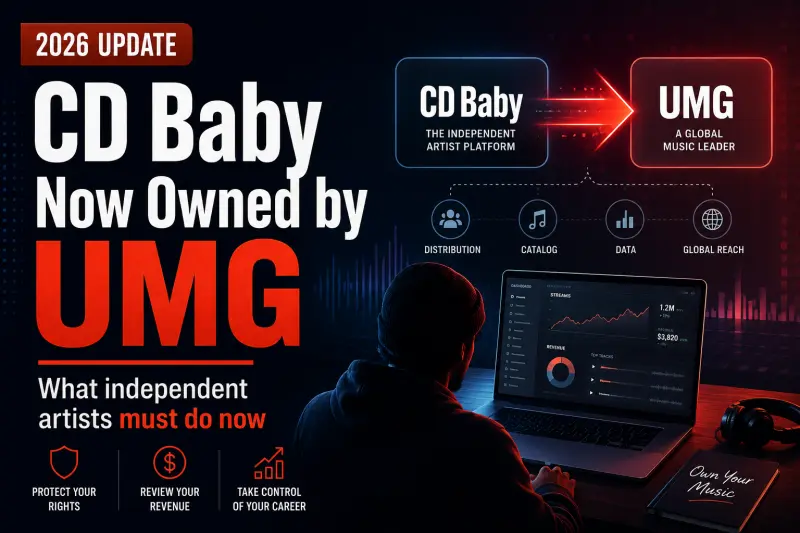
In February 2026, Universal Music Group’s Virgin Music Group completed its acquisition of Downtown Music Holdings — the company behind CD Baby, FUGA, Songtrust, Downtown Music Publishing, and several other music service businesses.
That one move has created a big question for independent artists:
Is CD Baby still safe to use?
And honestly, that question makes sense.
For years, CD Baby was seen as one of the most trusted options for DIY artists who wanted to release music without signing to a major label. Now that CD Baby is part of a structure connected to the world’s biggest music company, artists are naturally worried about control, data, royalties, long-term catalog safety, and whether they should start looking for alternatives.
This does not mean you need to panic or remove your music immediately.
But it does mean independent artists should stop being casual about distribution.
Here’s what changed — and what you should do now.
What Actually Happened to CD Baby?
CD Baby’s parent company, Downtown Music Holdings, was acquired by Virgin Music Group, which is owned by Universal Music Group.
Downtown’s portfolio included several major music service companies, including:
- CD Baby
- FUGA
- Songtrust
- Downtown Music Publishing
- Downtown Artist & Label Services
So CD Baby itself was not sold as a single standalone app. Instead, it became part of a much bigger acquisition involving Downtown Music Holdings.
This is why artists are now searching things like:
- “Is CD Baby safe?”
- “Who owns CD Baby now?”
- “Is CD Baby owned by UMG?”
- “Best CD Baby alternatives”
- “Should I leave CD Baby?”
The concern is not only about ownership. The concern is about what happens when a platform built for independent artists becomes connected to a major-label ecosystem.
Should Independent Artists Panic?
No.
But you should pay attention.
Your music will not automatically disappear just because ownership changed. Existing releases, royalties, ISRCs, UPCs, and store deliveries do not usually change overnight after a company acquisition.
However, acquisitions can lead to changes over time.
Those changes may include:
- new pricing
- updated terms of service
- new royalty reporting systems
- support changes
- new data policies
- dashboard changes
- distribution policy updates
- catalog migration rules
- changes in publishing administration services
The most important thing is this:
Do not make emotional decisions. Make documented decisions.
Before moving your music away from CD Baby or uploading new releases there, you should review your current catalog, your agreements, your royalty statements, and your future release strategy.
Why Artists Are Worried About UMG Owning CD Baby
Independent artists are worried because UMG is not a small distributor. It is one of the biggest music companies in the world.
CD Baby, on the other hand, built its reputation by serving independent musicians who wanted access to platforms like Spotify, Apple Music, YouTube Music, Amazon Music, TikTok, and Instagram without needing a major label.
That creates a trust issue.
Artists are asking:
Can a major-label-owned ecosystem truly serve independent artists without conflict?
That does not mean CD Baby will suddenly become bad. But it does mean artists have valid reasons to be cautious.
The biggest concerns are around data, control, transparency, and independence.
1. Check Your Current CD Baby Terms
Before doing anything else, log in to your CD Baby account and check the latest terms, payment rules, and distribution agreement.
Look carefully at:
- royalty percentage
- withdrawal rules
- takedown policy
- catalog ownership language
- Content ID policy
- publishing administration terms
- payout threshold
- tax form requirements
- rights you are granting to the platform
Do not rely on what you remember from 2023, 2024, or 2025.
After a major acquisition, policies may remain the same for some time, but they can also change later.
Your job is to stay ahead.
2. Download All Royalty Statements
This is very important.
Before making any major move, download your old royalty statements, payment records, tax documents, release metadata, and store delivery records.
Keep a backup of:
- song titles
- artist names
- release dates
- ISRC codes
- UPC codes
- royalty reports
- payout history
- publishing reports
- YouTube Content ID claims
- platform links
- takedown confirmations, if any
Why?
Because if you ever move your music to another distributor, you need clean records.
A distributor switch without proper records can create duplicate releases, lost playlist history, wrong royalty mapping, and ownership confusion.
3. Do Not Upload the Same Song Through Another Distributor Without a Plan
Many artists make this mistake.
They panic, create an account on another distributor, and upload the same song again.
That can cause problems.
You may end up with:
- duplicate Spotify versions
- duplicate ISRCs
- wrong artist profile mapping
- playlist loss
- royalty conflicts
- takedown delays
- store rejection
- YouTube Content ID disputes
If you want to move from CD Baby to another distributor, do it properly.
First, check whether your new distributor supports existing ISRCs and UPCs. Then plan the migration carefully.
In most cases, you should not blindly re-upload your music before understanding takedown timing and metadata matching.
4. Review Your Publishing Setup
This acquisition matters even more if you use Songtrust, publishing administration, or any publishing-related service connected to Downtown.
Distribution and publishing are not the same thing.
Distribution handles getting your music to streaming platforms.
Publishing administration handles songwriter royalties, composition royalties, and collection from publishing sources.
If your CD Baby setup is connected to publishing, make sure you know exactly where your publishing royalties are being collected from and whether any policy changes affect you.
Check:
- who is collecting your songwriter royalties
- whether you are registered with a PRO
- whether Songtrust or another admin is involved
- whether your compositions are correctly registered
- whether you can terminate or move publishing administration later
This is where independent artists should be extra careful.
Your master recording and your composition rights are different assets.
Do not treat them casually.
5. Watch for Pricing and Commission Changes
CD Baby has traditionally been known for a one-time payment model with commission-based royalty collection.
That model is different from subscription distributors like DistroKid and some other platforms.
After a large acquisition, artists should monitor whether anything changes in:
- release fees
- commission percentage
- YouTube monetization fees
- Content ID fees
- publishing administration fees
- payout charges
- optional marketing service costs
- customer support access
A small pricing change may not matter for one release.
But if you have a large catalog, every percentage matters.
6. Compare Alternatives Before Your Next Release
You do not need to leave CD Baby today just because ownership changed.
But before your next release, compare your options.
Look at:
- royalty percentage
- yearly fees
- one-time fees
- takedown policy
- support quality
- payout speed
- Content ID options
- publishing administration
- artist dashboard
- label account support
- YouTube, TikTok, Instagram, and Meta delivery
- ability to keep ISRCs when switching
Popular alternatives artists usually compare include:
- DistroKid
- TuneCore
- Ditto Music
- UnitedMasters
- Amuse
- RouteNote
- SoundOn
- Symphonic
- AWAL
- Last Play Distro
The best choice depends on your release strategy.
If you release every week, a subscription model may look attractive.
If you release fewer songs and want long-term catalog stability, a one-time or commission-based model may make sense.
If you are building a serious artist brand, support quality and transparency matter more than just the cheapest price.
7. Do Not Ignore Data and Platform Control
This is one of the biggest hidden issues.
Music distribution is not only about uploading songs.
Your distributor may hold or process important data, including:
- release metadata
- royalty data
- store performance
- payout history
- artist profiles
- YouTube Content ID information
- publishing information
- territory data
- label account details
When a distributor becomes part of a bigger company, artists naturally want to know how their data is handled.
Read the updated privacy policy and data policy carefully.
Especially check whether your data may be shared with affiliates, partners, subsidiaries, or related companies.
You may not understand every legal line, but you should at least know what rights you are giving.
Is CD Baby Still Safe?
For most artists, CD Baby is not suddenly unsafe.
Your catalog is not automatically in danger just because the company is now part of a UMG-owned structure.
But “safe” depends on what you mean.
If you mean:
Will my music instantly disappear?
Probably not.
If you mean:
Should I keep using CD Baby without checking anything?
No.
If you mean:
Should I review my rights, royalties, data, and alternatives?
Absolutely yes.
Independent artists should not blindly trust any distributor — not CD Baby, not DistroKid, not TuneCore, not anyone.
Your music is your business.
Treat your catalog like an asset.
Should You Remove Your Music From CD Baby?
Not immediately.
Removing your music without a plan can create more problems than it solves.
Before taking down your releases, ask yourself:
- Are my royalties being paid correctly?
- Do I have all my ISRCs and UPCs saved?
- Do I have a better distributor ready?
- Will my Spotify links stay the same?
- Will I lose playlist placements?
- Can I migrate without creating duplicates?
- Do I understand the new distributor’s terms?
If you cannot answer these questions, do not rush.
A smart artist does not panic-switch distributors.
A smart artist audits first, then moves carefully.
What Independent Artists Should Do Right Now
Here is the simple checklist:
- Log in to your CD Baby account
- Download royalty reports and release data
- Save all ISRCs and UPCs
- Check your current agreement
- Review publishing administration settings
- Read the latest privacy and data policy
- Compare alternatives before your next release
- Avoid duplicate uploads
- Keep backup records of everything
- Build a long-term catalog strategy
This is not about fear.
This is about control.
Final Thoughts
CD Baby becoming part of Universal Music Group’s ecosystem is one of the biggest independent music distribution stories of 2026.
Some artists will stay.
Some will leave.
Some will wait and watch.
But every independent artist should understand one thing:
Your distributor should serve your music career — not control it.
If CD Baby continues to offer transparent pricing, reliable payouts, good support, and fair policies, many artists may continue using it without issue.
But if you are serious about your music business, this is the right time to review your catalog, protect your data, compare your options, and make sure you are not dependent on one platform forever.
Independent artists do not need to panic.
They need to prepare.
FAQs
Is CD Baby owned by Universal Music Group now?
Yes. CD Baby became part of Universal Music Group’s wider ecosystem after Virgin Music Group completed its acquisition of Downtown Music Holdings, CD Baby’s parent company.
Is CD Baby still independent?
CD Baby still serves independent artists, but ownership-wise it is now part of Downtown under Virgin Music Group, which is owned by Universal Music Group.
Should I leave CD Baby now?
Not necessarily. You should first review your catalog, royalty reports, terms, publishing setup, and alternatives before making any move.
Will my music be removed from Spotify or Apple Music?
A company acquisition does not automatically mean your music will be removed. But artists should monitor emails, dashboard notices, policy updates, and royalty reports.
What are the best CD Baby alternatives?
Artists commonly compare DistroKid, TuneCore, Ditto, UnitedMasters, Amuse, RouteNote, SoundOn, Symphonic, AWAL, and newer independent distribution platforms.
Can I move my music from CD Baby to another distributor?
Yes, but you must do it carefully. Save your ISRCs, UPCs, metadata, royalty reports, and make sure your new distributor supports proper migration before re-uploading.
Is it safe to upload new music to CD Baby in 2026?
It depends on your needs. Before uploading new music, review the latest CD Baby terms, pricing, royalty structure, publishing options, and data policies.
Release Your Music Globally With Last Play Distro
With Last Play Distro, artists can distribute music globally to 150+ platforms, start on a Free tier where they keep 60% royalties, or upgrade to Premium tiers where they can keep up to 95% royalties.
- Global music distribution for independent artists
- Transparent royalties with plan-based royalty splits
- No fake partner, review, rating, or inflated artist-count claims